
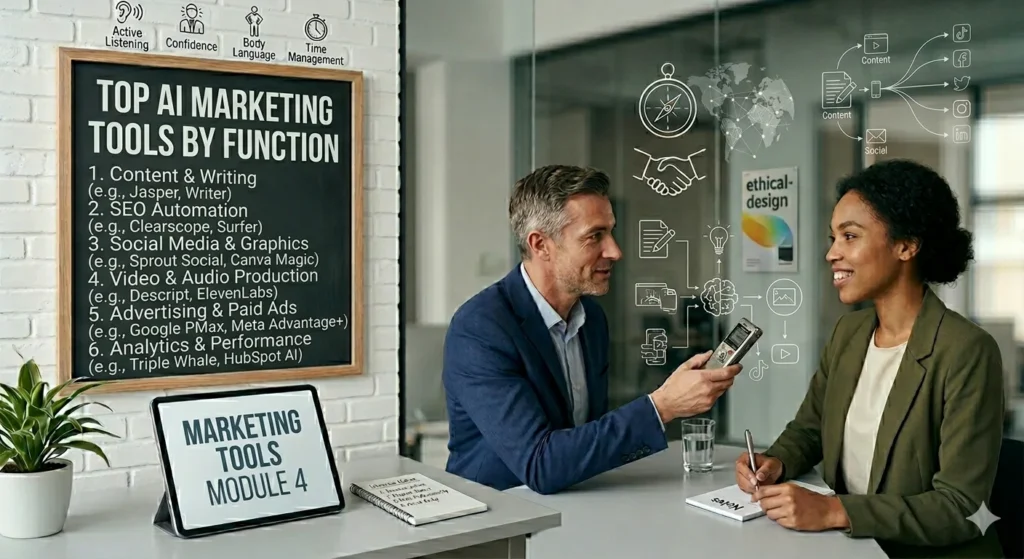
The Best AI Marketing Tools Every Marketer Should Know About
Introduction
Artificial intelligence has stopped being a buzzword and started being a business necessity. From automating repetitive tasks to predicting customer behavior and generating content at scale, AI is fundamentally reshaping how marketers work — and how fast they can grow.
But with hundreds of tools flooding the market, the real question isn’t “Is AI useful?” — it’s “Which AI tools are actually worth your time?”
This guide breaks down the best AI-powered marketing tools across every major category, so you can work smarter, move faster, and get better results.
Why AI Tools Matter in Modern Marketing
Before diving into the tools themselves, it’s worth understanding what they actually do for you.
AI marketing tools help you automate tedious workflows, personalize content at scale, uncover audience insights you’d never spot manually, optimize campaigns in real time, and free up your energy for the creative and strategic work that actually requires a human mind.
Used well, they don’t replace marketers — they make great marketers significantly more powerful.
1. Content Creation & Copywriting
ChatGPT (OpenAI) One of the most versatile AI tools available. Marketers use it to draft blog posts, write ad copy, brainstorm campaign ideas, repurpose content across formats, and generate first drafts that get refined into polished final pieces. It’s not a replacement for a skilled writer — but it dramatically speeds up the writing process.
Jasper AI Built specifically for marketing teams, Jasper helps create long-form content, social media posts, product descriptions, and email sequences with brand-consistent tone and voice. It integrates with SEO tools and supports team collaboration, making it ideal for content-heavy organizations.
Copy.ai Excellent for short-form copy — think ad headlines, taglines, product descriptions, and social captions. Great for marketers who need quick, punchy output without spending hours staring at a blank page.
2. SEO & Search Optimization
Surfer SEO Surfer analyzes top-ranking pages for any keyword and gives you a clear, data-driven content brief — including recommended word count, headings, semantic keywords, and structure. It removes the guesswork from on-page SEO entirely.
Semrush (AI Features) Semrush has deeply integrated AI into its platform — from keyword clustering and content gap analysis to AI-generated content suggestions and competitive intelligence. For serious SEO professionals, it remains one of the most comprehensive tools on the market.
Alli AI Designed for technical SEO at scale, Alli AI automates on-page optimization across large websites — updating meta tags, fixing keyword placements, and improving page scores without manual page-by-page editing.
3. Email Marketing & Automation
Klaviyo A powerhouse for e-commerce brands. Klaviyo uses AI to predict customer lifetime value, identify the ideal time to send emails to each subscriber, and trigger automated flows based on behavior. Its segmentation capabilities are among the most advanced in the industry.
Mailchimp (AI Features) Mailchimp’s AI tools now include predictive send time optimization, content suggestions, audience segmentation, and a subject line assistant that helps improve open rates before you hit send.
ActiveCampaign Combines email marketing with CRM and sales automation. Its AI-powered features help score leads, predict which contacts are most likely to convert, and automate highly personalized follow-up sequences based on user behavior.
4. Social Media Marketing
Lately AI Lately uses AI to analyze your existing long-form content — blogs, podcasts, videos — and automatically generates a library of social media posts optimized for engagement. It learns your brand voice over time and gets better the more content you feed it.
Hootsuite (OwlyWriter AI) Hootsuite’s built-in AI assistant helps generate post captions, repurpose content across platforms, and suggest the best posting times based on your audience’s activity patterns.
Predis.ai An AI tool built specifically for social media content creation. Upload a product or idea, and it generates ready-to-publish posts complete with visuals, captions, and hashtags — ideal for small teams and solo marketers.
5. Paid Advertising & Campaign Optimization
Google Performance Max Google’s AI-driven campaign type automatically optimizes ad placements, bidding strategies, and creative combinations across Search, Display, YouTube, and Gmail — all from a single campaign. It uses machine learning to find the highest-converting audiences in real time.
Meta Advantage+ Meta’s AI-powered ad system automates audience targeting, creative testing, and budget allocation across Facebook and Instagram. It’s particularly powerful for e-commerce brands running catalog and retargeting campaigns.
AdCreative.ai Generates high-performing ad creatives using AI trained on millions of real-world ad campaigns. You input your brand colors, logo, and copy — and it produces multiple creative variations with predicted performance scores.
6. Analytics & Customer Insights
Tableau (with AI features) Tableau’s AI capabilities help marketers visualize complex data, identify trends, and surface insights that would take hours to find manually. It connects to virtually any data source and makes dashboards genuinely actionable.
Brandwatch An AI-powered social listening and consumer intelligence platform. It tracks brand mentions, sentiment, and emerging trends across the web and social channels — helping marketers understand what their audience is talking about, and why.
Crimson Hexagon / Brandwatch Consumer Research Uses natural language processing to analyze billions of online conversations and extract meaningful insights about audience behavior, brand perception, and market trends.
7. Visual Content & Design
Canva (Magic Studio) Canva’s AI suite — Magic Write, Magic Design, Background Remover, and AI image generation — makes it easier than ever for non-designers to produce professional-quality visuals for social media, presentations, ads, and more.
Adobe Firefly Adobe’s generative AI tool, built directly into Creative Cloud apps. Marketers and designers use it to generate images, expand backgrounds, remove objects, and create visual assets from text prompts — all while staying inside their existing design workflow.
Runway ML For video-forward marketers, Runway offers AI-powered video editing — including background removal, motion tracking, text-to-video generation, and scene editing without professional video editing skills.
8. Chatbots & Conversational Marketing
Drift An AI-powered conversational marketing platform that qualifies leads, books meetings, and personalizes website experiences in real time through intelligent chatbots — so your sales team focuses only on the warmest prospects.
Intercom (Fin AI) Intercom’s AI agent, Fin, handles customer support conversations with human-level understanding. It resolves queries instantly, escalates complex issues, and reduces support ticket volume significantly.
ManyChat Automates conversations across Instagram, Facebook Messenger, and WhatsApp. Ideal for e-commerce brands that want to drive conversions, answer product questions, and recover abandoned carts through automated chat flows.
How to Choose the Right AI Marketing Tool
With so many options, the key is to avoid shiny-object syndrome. Ask yourself these questions before committing to any tool:
What specific problem am I trying to solve? Don’t adopt AI for the sake of it. Identify the bottleneck — whether it’s slow content production, poor email open rates, or inefficient ad spend — and find a tool built to address that.
Does it integrate with my existing stack? The best tool is one that fits into your current workflow without creating new friction.
Can I measure its impact? Every tool you invest in should have a clear metric tied to it — time saved, conversions increased, cost per lead reduced.
Is it scalable? A tool that works for a team of two should still work — and remain affordable — when your team grows to twenty.
Final Thoughts
AI marketing tools are no longer optional extras for forward-thinking teams — they’re becoming standard infrastructure for any marketer who wants to compete seriously in a crowded digital landscape.
The good news? You don’t need to adopt every tool on this list. Start with one area where you’re losing the most time or leaving the most results on the table. Master that tool. Measure the impact. Then expand.
The marketers who will win in the next five years aren’t those who fear AI — they’re the ones who learn to direct it.
written by sahina | best digital marketer in pattambi