
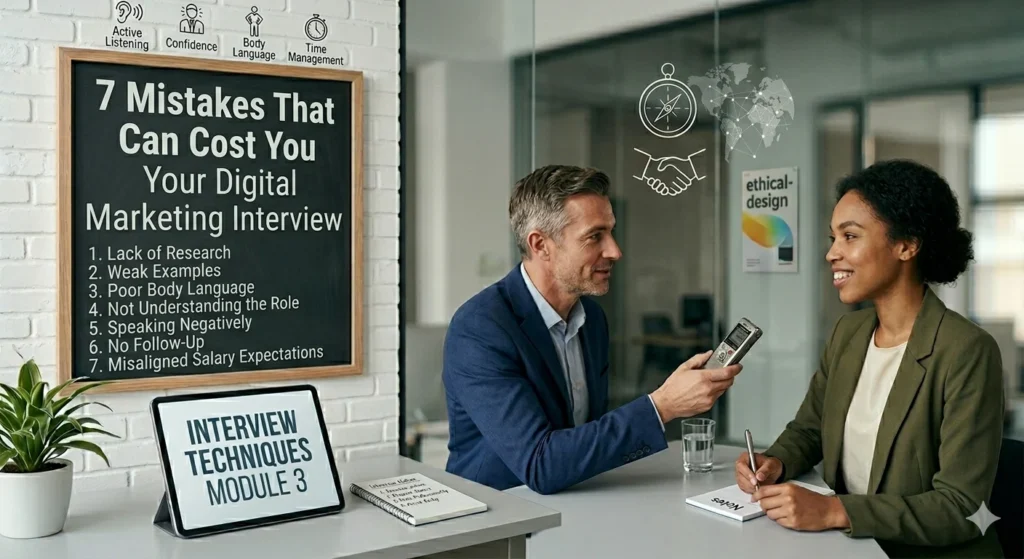
7 Mistakes That Can Cost You Your Digital Marketing Interview
Introduction
You’ve polished your resume, researched the company, and landed the interview. Now comes the part that most candidates underestimate — actually walking into that room (or joining that video call) and making a lasting impression.
Digital marketing interviews aren’t just about what you know. They’re about how you think, how you communicate, and how well you understand the ever-changing landscape of the industry. Even talented candidates lose opportunities not because of a lack of skill — but because of avoidable mistakes.
Here are seven things you should never do in a digital marketing interview.
1. Showing Up Without Researching the Company
Walking into a digital marketing interview without knowing the brand is one of the fastest ways to get eliminated from the process.
Before your interview, dig deep. Visit their website. Scroll through their social media. Read their recent blog posts. Check their Google rankings. Look at what ads they’re running. Notice what they’re doing well — and where the gaps might be.
When an interviewer asks “Why do you want to work here?” and you give a generic answer, it tells them you’re not genuinely interested. But when you say “I noticed your Instagram engagement has dropped over the last few months and I have some ideas around that” — you immediately stand out as someone who pays attention.
The rule: Know their digital presence better than they expect you to.
2. Talking About Skills Without Backing Them Up With Numbers
In digital marketing, data is everything. So when you claim to be good at something, you need to prove it.
Saying “I’m great at SEO” means very little. Saying “I grew organic traffic by 65% in four months by restructuring site architecture and targeting long-tail keywords” means everything.
Interviewers want specifics. They want to know what you did, how you did it, and what the result was. If you can’t attach a number or an outcome to your experience, it sounds like guesswork — not expertise.
The rule: Every claim needs a result. Every skill needs a story.
3. Pretending to Know Things You Don’t
Digital marketing is a broad, fast-moving field. Nobody knows everything — and experienced interviewers know that.
What they’re actually testing when they ask a tough question is not just whether you have the answer, but how you handle not having it. Bluffing or fabricating knowledge is one of the most damaging things you can do. Professionals can spot it immediately, and it destroys your credibility for the rest of the conversation.
It’s far more impressive to say “I haven’t worked directly with that tool, but here’s how I’d approach learning it quickly” than to pretend you’re an expert and fall apart under follow-up questions.
The rule: Honesty builds trust. Bluffing breaks it.
4. Being Vague About Your Specialization
Digital marketing is not one job — it’s a collection of specialized disciplines. SEO, paid media, content strategy, email marketing, social media, analytics — each one requires a different mindset and skill set.
One of the most common interview mistakes is trying to present yourself as equally good at everything. It sounds impressive on the surface, but it actually raises red flags. Companies are usually hiring for a specific need, and a candidate who claims to be a master of all channels often comes across as having no real depth in any.
Know your strengths. Own your specialty. Be clear about where you excel and where you’re still developing.
The rule: Be the expert in something, not a generalist in everything.
5. Ignoring Industry Trends and Recent Developments
If you haven’t kept up with what’s happening in digital marketing lately, it will show — and it will hurt you.
Interviewers often ask questions like “What’s your take on the shift toward short-form video?” or “How do you think AI is changing content marketing?” These questions aren’t meant to trick you. They’re meant to see if you’re genuinely engaged with the industry or just recycling knowledge from a course you took two years ago.
Subscribe to industry newsletters. Follow thought leaders on LinkedIn. Read platforms like Search Engine Journal, Marketing Week, and HubSpot’s blog. Stay curious — not just before the interview, but as a daily habit.
The rule: Show them you live and breathe this industry, not just study it for interviews.
6. Failing to Ask Thoughtful Questions
Most candidates treat the end of an interview as a formality. When the interviewer asks “Do you have any questions for us?” they say something like “No, I think you’ve covered everything” — and in doing so, they miss a golden opportunity.
Asking smart, well-considered questions shows genuine interest, strategic thinking, and professionalism. It also helps you evaluate whether the role is actually right for you.
Consider asking things like:
- “What does success look like in this role after the first 90 days?”
- “What are the biggest challenges your marketing team is currently facing?”
- “How does the marketing team collaborate with sales and product?”
The rule: Great questions leave a stronger impression than perfect answers.
7. Underestimating the Importance of Soft Skills
Many digital marketing candidates walk in prepared to talk about tools, platforms, and tactics — but forget that marketing is ultimately about people.
Creativity, communication, adaptability, collaboration, and critical thinking are not secondary qualities in this field. They’re central to it. A marketer who can’t communicate ideas clearly, work under pressure, or adapt when a campaign isn’t performing is a liability — regardless of how technically skilled they are.
Don’t just demonstrate that you know how to use Google Ads. Show that you can think on your feet, collaborate across teams, handle feedback gracefully, and bring ideas to the table.
The rule: Tools can be taught. Mindset is what they’re really hiring for.
Final Thoughts
A digital marketing interview is your chance to show not just what you know — but who you are as a marketer. The candidates who win aren’t always the most technically advanced. They’re the ones who come prepared, speak with clarity, back their experience with evidence, and show genuine passion for the craft.
Avoid these seven mistakes, and you’ll already be ahead of most people in the room.
written by sahina | Best Digital Marketer In Pattambi